• +1 (877) 708-0005
  • info@chang-castillo.com
Chang-Castillo and Associates
Translators and Interpreters

One World, Many Languages,
One Company, Worldwide™

  • Home
  • Services
    • Translation
      • Certified Translations
    • Interpretation
    • Remote Simultaneous Interpretation (RSI)
    • Hybrid Interpretation Services
    • Interpreting Equipment Rentals
    • Subtitling and Transcription Services
  • Languages and Locations
  • Frequently Asked Questions
  • About Us
  • Blog
  • Contact
MENU CLOSE back  

Translation Services in Austin, TX: Legal, Government, Medical and Technical Documents

You are here:
  1. Home
  2. Translation Services in Austin, TX: Legal, Government, Medical and Technical Documents
Austin, Texas

Chang-Castillo and Associates (CCA) provides Austin translation services for legal, government, technical and medical documents. Each document gets professional translation into the reader’s native language and a dedicated project manager from quote to delivery. The firm also staffs conference interpreters for Austin meetings and hybrid events.

As a translation agency headquartered in San Francisco, CCA has no Austin office. Translation is handled remotely through a dedicated project manager, and Austin interpreting assignments are staffed from CCA’s network of conference interpreters.

Request a free quoteor call (877) 708-0005 with the languages, the document type and the date you need it.

Downtown Austin, Texas, seen across Lady Bird Lake

Legal and Government Translation for Austin Courts, Agencies and the Capitol

CCA provides legal translation and government document translation, and when the reader is an Austin court or agency, that body’s deadline sets how early the work has to start.

Passport and certificate, typical documents for translation in Austin, Texas

Austin’s legal and government paperwork converges downtown. Travis County’s civil district courts, county courts at law and child-support court sit at 1700 Guadalupe Street. The criminal courts operate from the Blackwell-Thurman Criminal Justice Center on West 11th Street, the Western District of Texas clerk’s office is on West Fifth Street, and the Capitol is on Congress Avenue. Legal document translation from CCA covers contracts, filings and agency paperwork for those readers.

Texas Rule of Evidence 1009 shows how tight that timing can be. Under Rule 1009, a translation of a foreign-language document is admissible if, at least 45 days before trial, the party offering it serves the translation, the underlying document and an affidavit or unsworn declaration from a qualified translator. The declaration sets out the translator’s qualifications and certifies accuracy. Objections to accuracy are due at least 15 days before trial, and the court can change these times for good cause. It is a Texas state-court rule, so confirm the deadline that applies to your filing with counsel.

When you request a quote, name the receiving body and the filing deadline in the form’s comments box. If the filing falls under Rule 1009, ask in the same box whether CCA can provide the translator’s declaration the rule calls for, so the deadline and that requirement can be discussed when CCA prepares the quote.

Legislative work has its own calendar. The 90th Legislature opens bill filing on November 9, 2026, and the regular session convenes at noon on January 12, 2027. Organizations preparing multilingual hearing guides, public-comment forms or notices around the session should schedule translation before it convenes.


Technical and Medical Documents for Central Texas Technology and Health Organizations

Technical and medical translation differ from general document work in precision. The translator follows the conventions of the target language, because a misunderstanding could have severe consequences, and the difference between commas and decimal points in numbers is one example. Formatting is chosen for the reader who speaks the target language.

The Dallas Fed describes government, education and the technology industry as the underpinnings of Austin’s economy, with the State of Texas the largest employer, followed by the University of Texas. It reports information-technology manufacturing and services concentrated at nearly three times the U.S. level, and a health cluster that employs 7.4% of Austin’s workforce. For technology and manufacturing organizations, that means technical data sheets, technical manuals and training materials; for health and life-science organizations, patient-facing and clinical documents.

Technical document translation covers technical data sheets, which can include how-tos, components, materials, maintenance and security measures, plus diagrams and schematics. CCA’s translators know the field and can get access to relevant documentation. For a manual set, glossary management and management of in-country review cycles are available, and when a project needs it, IT specialists, engineers and desktop publishers handle its technical requirements. Where the content lives on a website or inside software, website and software localization applies the same discipline.

Medical and life-science translation covers clinical trials, drug registration documentation, protocols, patient recruitment documents, package inserts and labels, and side effect warnings. Translators on a medical team must also have prior experience in medical translation, and all of CCA’s linguists have signed a non-disclosure agreement. For a university or research office, translation covers presentations, training materials and program websites.

Spanish Translation and the Other Languages Behind Local Documents

Spanish is the largest language other than English in Austin, and the variant a document is written in matters as much as the language.

The 2024 American Community Survey 1-year estimates show that 33.2% of Austin residents age 5 and over speak a language other than English at home, and 21.5% speak Spanish. About 109,152 residents, or 11.5%, speak English less than “very well,” including 79,620 Spanish speakers, who are 39.1% of all Spanish speakers in the city. For an agency, clinic or employer, those are the readers a translated notice has to reach. In the 2023 estimates, Chinese, Hindi, Urdu, Vietnamese, Telugu, Tamil and Korean are among the most-spoken languages after Spanish.

Each translation is adapted to its target market, and the translators work only into their native language. For Spanish translation, that means choosing between Latin American and European Spanish. Tell the project manager who will read the document: patients in Central Texas, a business partner in Mexico or a distributor in Spain. That reader decides whether the translator writes Latin American or European Spanish.

For any other language, name the language pair in your quote request.


How a Remote Translation Project Runs for Someone in Austin

A dedicated project manager is in charge of each document translation from the start of the project to final delivery.

Because the work is remote, the project manager is your single point of contact. Behind that contact sit no fewer than three separate linguists: a translator, an editor and a proofreader. The second and third readers review what the first produced.

Rush service is available for short deadlines. State the deadline when you request the quote so it can be discussed there.

A free quote depends on the language pair, the length and complexity of the document, the format of the source files and the deadline. For interpreting, it depends on the languages, the session length, the number of sessions and whether equipment or RSI is needed. The quote form asks for translation or interpretation, interpretation type, event name, subject, date and start time, city and country, and language pair. The document type and the deadline go in the “Additional information/comments” box.

What to have ready Translation project Interpreting assignment
Subject Document type and subject (contract, manual, notice, website) Event name and subject
Languages Source and target language, and who will read the result Languages interpreted, and the interpretation type
Date Deadline, entered in the comments box Date and start time, with session length
Location Where the document will be filed or read City and country, or the virtual platform
Extras Source file format and any instructions from the receiving body Equipment needs and number of sessions

Use the table as a checklist, then request a free quote.


Conference Interpreting for Austin Meetings and Hybrid Events

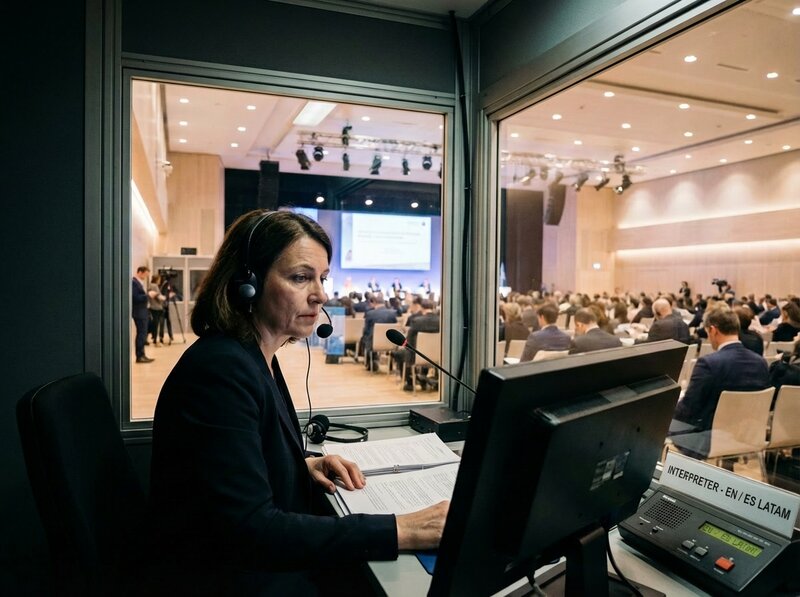
A translator works on written text and an interpreter works on speech, and CCA supplies conference interpreters for Austin meetings, trade shows and hybrid events. For interpreting, assignments in Austin are staffed per event from the network, and remote simultaneous interpreting (RSI) serves virtual and hybrid sessions.

Simultaneous interpreter working in a soundproof booth at a conference, as for an Austin event

Four formats cover most rooms. Simultaneous interpretation suits conferences and formal multilingual sessions: interpreters work in booths and listeners hear the interpretation as the speaker talks. Consecutive interpretation suits small meetings, where the interpreter speaks after each segment and no equipment is needed.

Remote simultaneous interpretation places the interpreters in another location and delivers their voices through an online platform, which fits virtual events. Hybrid interpretation serves a room with remote participants, so those in the room and those online follow the same session in their own language.

CCA’s conference interpretation service delivers all four formats. Its event interpretation services cover conferences, seminars, workshops, business meetings and training courses, and the same formats serve trade shows. The firm also rents interpreting equipment for sessions held in a room.


Who Interprets and Translates: Credentials Behind the Work

CCA is owned and operated exclusively by translators and interpreters, so the standard for your project is set by people who have done the work themselves. Every interpreter it staffs holds at least two of five conference-level credentials.

The five credentials are:

  • 1
    An MA or PhD in conference interpretation from a recognized school
  • 2
    AIIC membership, granted through peer review
  • 3
    TAALS membership, granted through peer review
  • 4
    At least five years of conference interpreting experience and proof of at least 200 days of conference-level work
  • 5
    Accreditation with the UN, Canada’s federal government (conference level), the EU’s interpretation directorate, the US Department of State (conference level) or NAATI Level 5

Recognized schools include graduate programs such as the Monterey Institute, UMD, ESIT and ETI. The roster includes professionals who have worked with UN agencies, at G8 and G20 summits, at the Olympic Games and at presidential and ministerial meetings.

Translators work only into their own native language and hold professional translator training and credentials. These are conference-level credentials, a different matter from court interpreter licensing, which the hearings question below addresses.

Request a free quote for a translation project or an interpreting assignment.


Questions Austin Buyers Ask Before They Request a Quote

What does “certified translation” mean, and what does CCA offer?

The firm’s published certified translation service is for French only: English or Spanish into French and French into English, for the French Consulate in San Francisco and for California and US courts. Beyond that, what “certified” means depends on who receives the document. For federal immigration filings, 8 CFR 103.2(b)(3) asks for a full English translation that the translator has certified as complete and accurate, with the translator’s certification that they are competent to translate. The receiving body decides what it accepts, so send its instructions with your quote request.

Does a translation going abroad need to be notarized for a Texas apostille?

The Texas Secretary of State’s apostille guide says translations “must contain a statement and signature from the translator describing what was translated and a proper notarial certificate with a notary signature, seal, and date.” A notary performs the notarizing, separately from the translation. If a document is headed for an apostille, say so when you request the quote, name the destination country and ask what CCA can provide for that requirement.

Which documents should a Central Texas agency or nonprofit translate first?

Translate the documents people must act on first: notices, forms, and instructions for services or safety, ahead of background material. A Texas state agency’s language access plan applies a four-factor analysis and a prioritization standard to written translation, and its public notices carry English and Spanish instructions. List your documents in priority order in the quote request, with the languages each one needs.

Can CCA’s interpreters work a Travis County hearing or a deposition?

CCA’s interpreters are conference interpreters, not licensed court interpreters. Texas Government Code 57.002 requires a court, on a party’s motion or a witness’s request, to appoint a licensed court interpreter in a civil or criminal proceeding. In counties of 50,000 or more, a non-licensed interpreter is allowed only for a language other than Spanish and only if no licensed interpreter is available within 75 miles. Travis County is one of those counties on the Judicial Branch Certification Commission’s list, which uses the 2010 census. The Commission’s FAQ counts depositions as court proceedings. Confirm requirements with counsel.

How does the closed Austin Convention Center change interpreter and booth planning?

The Austin Convention Center closed in April 2025 for rebuilding and is expected to reopen in spring 2029. Until then, large meetings need other venues, so booth planning starts with the specific room. Send the venue, room layout, attendee count and whether sessions run in parallel, since booths and equipment depend on the room. RSI can cover virtual or hybrid sessions, and CCA rents interpreting equipment for rooms.


Request a Free Quote for Your Austin Project

Send the details through the online quote form, call (877) 708-0005 or email info@chang-castillo.com.

Request a Free Quote


Need Interpretation Services?

Request a Quote

Connect
Follow Us On Facebook Join us on LinkedIn Follow Us On Twitter
(877) 708-0005
info@chang-castillo.com

Proud Member Of:
Member AIIC Member Calliope Member Taals
Latest Blog Posts
  • La Francophonie: A Whole French-Speaking World
    January 11, 2026
  • The Complete Guide to Simultaneous Interpretation Equipment
    January 11, 2026
  • The 3 Hardest Languages to Interpret (And Why Professional Interpreters Master Them)
    January 6, 2026
Contact Us

Request a Quote

Copyright 2026 Chang-Castillo and Associates