• +1 (877) 708-0005
  • info@chang-castillo.com
Chang-Castillo and Associates
Translators and Interpreters

One World, Many Languages,
One Company, Worldwide™

  • Home
  • Services
    • Translation
      • Certified Translations
    • Interpretation
    • Remote Simultaneous Interpretation (RSI)
    • Hybrid Interpretation Services
    • Interpreting Equipment Rentals
    • Subtitling and Transcription Services
  • Languages and Locations
  • Frequently Asked Questions
  • About Us
  • Blog
  • Contact
MENU CLOSE back  

Mexico City Interpreters for Conferences, Negotiations and Hybrid Meetings

You are here:
  1. Home
  2. Mexico City Interpreters for Conferences, Negotiations and Hybrid Meetings
Mexico City, Mexico

Chang-Castillo and Associates (CCA) provides Mexico City interpreters for conferences, negotiations, board meetings and sessions that include people elsewhere. The formats are simultaneous for conferences, consecutive for negotiations and small meetings, and remote and hybrid for mixed audiences. Interpreting equipment and an on-site technician come in the same package. English-Spanish business documents can be translated alongside.

CCA is headquartered in San Francisco and has no office in Mexico; assignments are staffed from its network of locally based interpreters around the world.

CCA is owned and operated by interpreters, and every interpreter must hold at least two of five credentials.

Request a Free Quote

Office towers of a Mexico City business district, with mountains in the haze behind

Reforma, Polanco, Santa Fe and Beyond: Which Interpreting Format Fits the Room

The room decides the format: booths and receivers for large halls, interpreters who take turns with the speaker for boardrooms and negotiations.

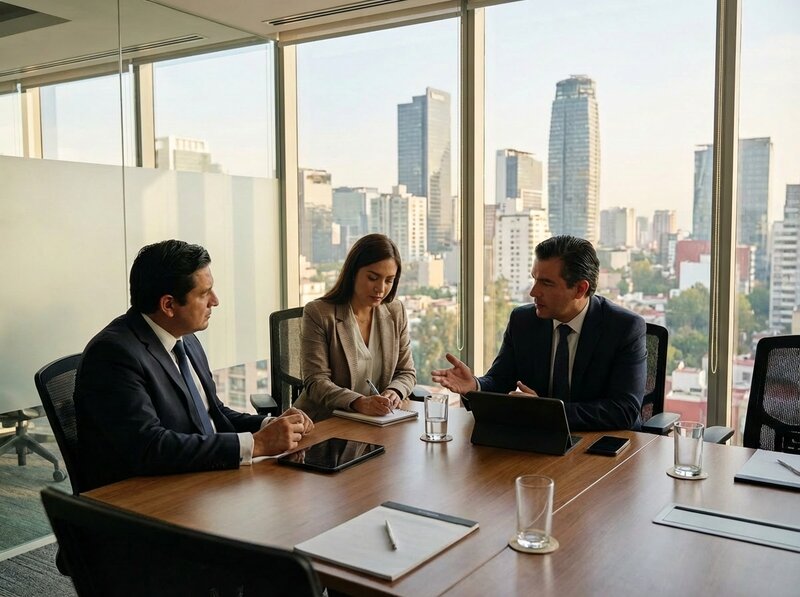
Interpreter taking notes between two negotiators at a boardroom table, as at a Mexico City meeting

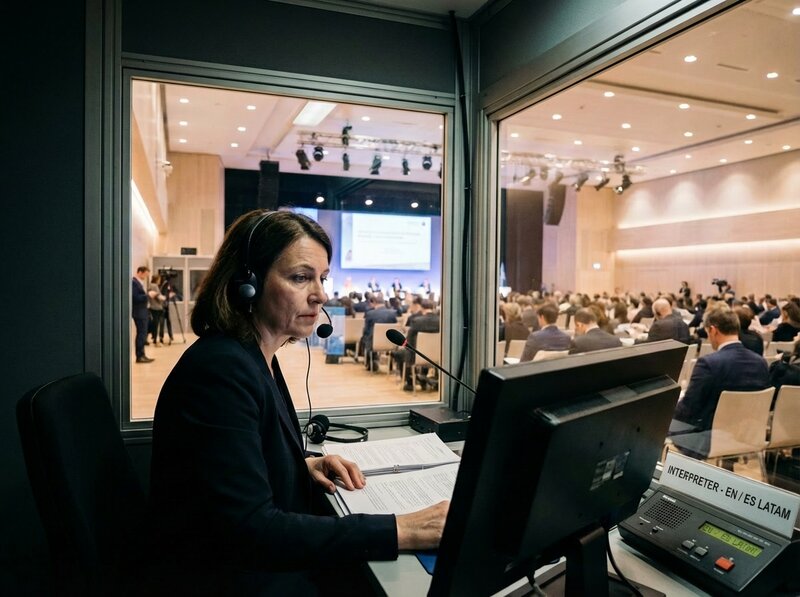
Exhibition halls with column-free floors, convention complexes in Santa Fe and Nápoles, and university halls in the historic center are the kinds of rooms where simultaneous interpretation is the usual professional choice, though no venue requires it. Interpreters work in teams in soundproof booths while participants wear headsets and hear the interpretation in their own language in real time.

Small discussion groups, business negotiations and meetings where dialogue matters suit consecutive interpretation. The interpreter waits for the speaker to finish a statement, then conveys it in the target language, which keeps the exchange personal. A meeting with a plenary in one room and a negotiation in another can use both formats, and CCA’s conference interpreters work in either.

Mexico City is the capital and the seat of the federal powers under Article 44 of the Constitution. The city government counts some 86 embassies, most along the Paseo de la Reforma corridor, in the Cuauhtémoc and Juárez neighborhoods, or in Polanco, and describes Santa Fe as glass corporate towers and one of the country’s most dynamic financial zones.

Multilateral bodies meet here too: the United Nations regional commission for Latin America and the Caribbean (ECLAC) has had its subregional headquarters for Mexico in the city since 1951, serving 10 countries.


Scheduling Remote and Hybrid Sessions When Only One Side Changes Its Clocks

Mexico City stays on UTC-6 all year, while most of the United States moves its clocks twice a year, so the gap changes by one hour.

Mexico’s time-zone law, published on 28 October 2022 and in force from 30 October 2022, ended daylight saving time for most of the country. Only listed northern-border areas keep a seasonal clock. United States daylight time runs from the second Sunday of March to the first Sunday of November. A recurring invitation set in local Mexico time therefore drifts against US calendars each March and November.

The sessions this affects are remote simultaneous interpretation (RSI) and hybrid interpretation. A hybrid session brings on-site simultaneous and consecutive interpreting together with RSI: people in the room listen through headphones, and remote participants use an app on their own device.

If the session starts at noon in Mexico City, the time elsewhere is:

US zone During US standard time (early November to mid-March) During US daylight time (mid-March to early November)
Eastern 1:00 p.m. 2:00 p.m.
Central 12:00 p.m. 1:00 p.m.
Mountain 11:00 a.m. 12:00 p.m.
Pacific 10:00 a.m. 11:00 a.m.

The table applies to most of the United States. Write each time with the attendee’s own zone label, and confirm each attendee’s zone. A schedule that spans several Mexican cities needs each one confirmed too: Quintana Roo, where Cancún is, stays on UTC-5 all year.


Interpreter Teams, Booths and the On-Site Technician

For a meeting interpreted between English and Spanish in both directions, AIIC’s professional standards (version of 16 January 2022) call for three interpreters, in one booth or two, or two interpreters for short or general meetings when both work in both directions.

Simultaneous interpreter working in a soundproof booth at a conference, as for a Mexico City event

A normal working day is no more than two sessions of 2.5 to 3 hours. These are the standards professional interpreters work to. They are not Mexican law and not a promise from CCA. Give CCA the languages, session hours and format in your request, and the team can be planned around them.

CCA’s interpreting equipment rental covers fully enclosed soundproof booths, microphones, interpreter consoles, portable transmitters for tours or demos, receivers, infrared emitters, FM equipment, conference technicians, complete A/V equipment support, and participant headsets and receivers, in one package. Every interpretation package includes an onsite technician who sets up and monitors the equipment for the entire event.

To plan an event, send the event date, the city and country, the language pairs and the session type, and request a free quote.


What Mexican Courts and Offices Ask of a Translated Document

Mexican commercial proceedings generally require a Spanish translation of any foreign-language document filed.

That rule sits in Article 1055, section II, of Mexico’s Commercial Code. Civil procedure rules provide for a translation by a perito traductor when a translation is contested, and Article 1461 requires a translation made by an official perito to recognize an arbitral award in a language other than Spanish.

A perito is a court-recognized expert, designated by the parties or the court, who swears to tell the truth. The city’s judiciary publishes an official list of these experts, translators among them, and updates it periodically.

A US public document going to Mexico follows a usual order. Both countries are party to the Hague Apostille Convention, in force for the United States since 1981 and for Mexico since 1995. The apostille comes first, from the US authority that issued the document, which for state-issued documents is generally the issuing state’s Secretary of State. Mexican consulates take no part. The apostille certifies the official’s signature or seal, not the content. Translation into Spanish then goes to a perito authorized by the relevant state high court, according to Mexico’s foreign ministry consular guidance. Ask the receiving office whether the apostille itself must also be translated.

CCA translates business documents. Perito translations come from the court-listed experts described above, and apostilles from the authority that issued the document. The receiving court or office decides what it accepts, so name it in your quote request.


English-Spanish Business Documents CCA Translates

CCA’s translation services cover legal and government documents, corporate communications, marketing materials and technical manuals between English and Spanish.

The full list also includes training materials, websites and software, speeches and presentations, and any other type of documentation. For a company writing to Mexican readers, that can include contracts, product literature and manuals. If the readers are in Mexico, say so in the quote request.

Each project gets a dedicated project manager from inception to final delivery. No fewer than three separate linguists work on it: a translator for the first draft, an editor who checks meaning and style, and a proofreader who looks for typos, punctuation errors and formatting issues. IT specialists, engineers and desktop publishers join when the project needs them. Glossary management, in-country review cycles, multilingual desktop publishing, subtitling and transcription are available as well. CCA’s translators are native speakers of the language they translate into. Rush service is available for short deadlines.

To start, request a free quote. Put the document type and deadline in the form’s “Additional information/comments” box, and name the receiving court or office if one applies.


Who Staffs an Assignment in Mexico City: Credentials and Coverage

CCA staffs interpreting assignments from its worldwide network of locally based interpreters. It also serves other destinations in the region, such as Panama City.

Under CCA’s interpretation services standards, every interpreter must hold at least two of these five credentials:

  • 1
    An MA or PhD in conference interpretation from a recognized interpretation school.
  • 2
    Membership in AIIC, the International Association of Conference Interpreters, available only through peer review.
  • 3
    Membership in TAALS, the American Association of Language Specialists, also available only through peer review.
  • 4
    At least five years of conference interpreting experience and proof of at least 200 days of simultaneous or consecutive conference-level work.
  • 5
    Accreditation or certification with the United Nations, the Federal Government of Canada (conference level), the European Union’s interpretation directorate (SCIC), the US Department of State (conference level) or NAATI Level 5, Conference Senior Interpreter (Australia).

CCA’s conference interpreters regularly work with the United Nations family of agencies and at events such as G-8/G-20 summits, the Olympic Games, and presidential and ministerial meetings.

The firm is interpreter-owned, and describes itself as the only service of its kind owned and operated by interpreters. Both co-owners are conference interpreters and members of AIIC and TAALS, with master’s degrees from the Monterey Institute of International Studies. Pablo Chang-Castillo, President and CEO, works in English (A), Spanish (A), French (B) and Brazilian Portuguese (C), and his clients include the American and Canadian governments and the United Nations family of organizations. Julien Brasseur, Chief Operations Officer, works in French, English and Spanish.


Answers on Contracts, Origin Certificates, Spanish and Remote Interpreters

Does an English-language contract with a Mexican supplier need a Spanish version?

Mexican law requires standard-terms contracts with consumers to be written in Spanish to be valid (Federal Consumer Protection Law, Article 85). For a contract between two businesses, ask your counsel whether a Spanish version is needed. CCA can translate the agreement either way.

Does a USMCA certification of origin have to be in Spanish?

USMCA (T-MEC in Mexico) Article 5.2(5) lets the certification be completed in English, French or Spanish, and the importing country may ask for a translation into its language. Your customs broker or counsel can tell you how Mexican customs handles that request, including the form it takes and who prepares the translation. The agreement remains in force and is now subject to annual review. CCA translates the document and does not offer customs advice.

Is Mexican Spanish different enough from Spain Spanish to matter for a brochure or contract?

Yes, in places. The Academia Mexicana de la Lengua notes that Mexican Spanish has no plural “vosotros” or “vuestro”, which Spain-Spanish texts use. The verb “coger” is ordinary in Spain but taboo in most of the Americas, and it can embarrass a sender. When you request a quote, mention that the text is for readers in Mexico. CCA’s Spanish translation and interpreting page describes its Spanish work.

Can the interpreters work remotely while our team sits in a meeting room in Mexico?

Yes, through remote simultaneous interpretation (RSI), which CCA provides without requiring the interpreters to be at the venue. AIIC’s distance-interpreting guidelines (May 2025) note that when only the interpreting is remote, an audio or video problem affects only the interpreters, who cannot easily signal it to the room, and AIIC recommends remote shifts of no more than 15 to 20 minutes. Say in your quote request that the room is in Mexico and the interpreters are remote.

Do product labels and marketing materials for Mexico have to be in Spanish?

Yes. Article 34 of the Federal Consumer Protection Law requires product data, labels, packaging and related advertising to be in Spanish, with other languages allowed in addition. The labeling standard NOM-050-SCFI-2004 follows the same rule and is listed as in force on the Secretaría de Economía portal. Checking compliance falls to you or your adviser. CCA translates marketing materials and technical manuals but does no label-compliance review.


Send Your Event Dates or Documents to CCA for a Free Quote

Request a free quote through the contact form, by phone at (877) 708-0005 or by email at info@chang-castillo.com. For an event, include the date, city, language pairs and session type; for a document, its type and deadline.

Request a Free Quote


Need Interpretation Services?

Request a Quote

Connect
Follow Us On Facebook Join us on LinkedIn Follow Us On Twitter
(877) 708-0005
info@chang-castillo.com

Proud Member Of:
Member AIIC Member Calliope Member Taals
Latest Blog Posts
  • La Francophonie: A Whole French-Speaking World
    January 11, 2026
  • The Complete Guide to Simultaneous Interpretation Equipment
    January 11, 2026
  • The 3 Hardest Languages to Interpret (And Why Professional Interpreters Master Them)
    January 6, 2026
Contact Us

Request a Quote

Copyright 2026 Chang-Castillo and Associates