
Christmas Traditions from Around the World: Nicaragua
Holiday Traditions Around the World: A Cultural Guide
More than 160 countries celebrate Christmas in some form, yet “Christmas” means something entirely different in Tokyo than it does in Reykjavík. Add Hanukkah, Kwanzaa, Diwali, Lunar New Year, and dozens of regional harvest festivals, and the winter season becomes a mosaic of traditions that vary not just by country but by region, religion, and community.
For anyone working across cultures—diplomats, business executives, international organizations—understanding these traditions isn’t optional. It determines when to schedule meetings, what gifts are appropriate, and how to communicate respect. A Japanese client may not celebrate Christmas religiously but will absolutely expect you to understand the KFC phenomenon. A Swedish colleague might seem distracted in mid-December because St. Lucia’s Day matters more than December 25th.
This guide maps the major winter celebrations across four continents, highlighting the native terminology and cultural context that distinguish genuine understanding from surface-level awareness.
European Winter Traditions
Europe’s winter celebrations reflect two millennia of religious, pagan, and regional influences layered atop one another. The result: traditions that can vary dramatically within a single country.
Northern Europe
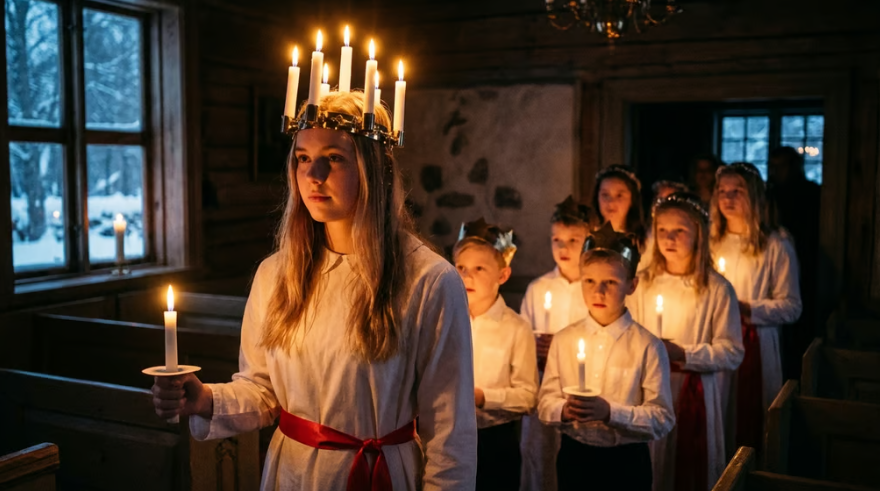
Sweden begins its winter season on December 13th with Luciadagen (St. Lucia’s Day), when the eldest daughter in each family dresses in white robes and a crown of candles, leading processions and serving saffron buns. The tradition honors a 4th-century Sicilian martyr but has become uniquely Swedish in its expression.
Sweden’s other iconic tradition is the Gävle Goat (Gävlebocken)—a towering straw structure standing 42 feet high and 23 feet wide, erected each December since 1966. The goat has achieved international fame partly because vandals frequently attempt to burn it down, creating an unofficial tradition within the tradition.
Norway preserves the Julbukk (Yule Goat) tradition in its original form: costumed figures traveling door-to-door, an ancestor to modern caroling. Norwegian families also prepare Nissegrøt (rice porridge) for the Fjøsnissen, protective barn spirits believed to guard livestock through winter.
Finland elevates the sauna to sacred status during Christmas. The Joulusauna (Christmas sauna) on December 24th serves as ritual purification before evening celebrations. Families believe the Saunatonttu (sauna elf) watches over this tradition—bathing respectfully honors the spirits.
Iceland hosts perhaps the most elaborate pre-Christmas countdown: 13 Jólasveinar (Yule Lads) visit children over 13 nights, each with distinct personalities ranging from mischievous to helpful. Children leave shoes on windowsills and receive either treats or rotting potatoes depending on behavior. The tradition includes darker figures—the ogress Grýla and the Jólakötturinn (Christmas Cat), said to devour children who haven’t received new clothes.
Iceland is also famous for Jólabókaflóð (the Christmas Book Flood), a tradition of exchanging books on Christmas Eve and spending the night reading. The custom originated during World War II when paper remained one of few unrationed commodities.
Central Europe
Germany claims credit for the modern Christmas tree, with legend attributing the first decorated tree to Protestant reformer Martin Luther. Germans also pioneered artificial trees—originally crafted from dyed goose feathers—and the Advent calendar tradition. The gift-giver varies by region: southern Germany favors the Christkind (Christ Child), while northern regions lean toward der Weihnachtsmann (Santa Claus).
Austria and Bavaria share the Krampusnacht tradition on December 5th-6th, when costumed figures representing Krampus—St. Nicholas’s demonic counterpart—roam streets carrying birch switches and chains. Far from child-friendly entertainment, traditional Krampus runs involve elaborate costumes and genuine attempts to frighten onlookers. The tradition has gained international attention, with Krampus-themed events now appearing across Europe and North America.
Poland observes Wigilia on Christmas Eve, featuring precisely 12 meatless dishes representing the 12 apostles. The meal begins only when the first star appears and traditionally includes sharing the Opłatek—a thin wafer symbolizing reconciliation, broken and exchanged between family members with wishes for the coming year.
Southern Europe
Italy celebrates La Befana, a benevolent witch who delivers gifts to children on Epiphany Eve (January 5th). Legend holds that Befana was invited to accompany the Magi to visit the Christ child but declined; she’s been searching ever since, leaving gifts for good children and coal for bad ones. In southern Italy, Zampognari (holiday bagpipers) descend from the mountains to play traditional Christmas music in town squares.
Spain and particularly Catalonia maintain some of Europe’s most unusual traditions. The Caganer—a figure depicted in a squatting, defecating pose—appears in Catalan nativity scenes, believed to fertilize the earth and bring prosperity. The Tió de Nadal (Christmas Log), also called Caga Tió, involves children “feeding” a hollow log throughout December, then beating it with sticks on Christmas Eve while singing commands for it to “poop” gifts.
France celebrates with regional variations: eastern and northern regions begin on December 6th (St. Nicholas Day), while Lyon holds la Fête de Lumières on December 8th with millions of candles illuminating the city. French crèches (nativity scenes) feature Santons—small hand-painted clay figurines depicting not just the Holy Family but entire village populations. Christmas Eve culminates in le Réveillon, an elaborate feast following midnight mass, ending with the Bûche de Noël (Yule log cake).
Greece displays Karavaki (decorated boats) rather than Christmas trees—a nod to Greece’s maritime heritage. Between December 25th and January 6th, Greeks ward off Kallikantzaroi, goblin-like creatures from folklore, by hanging colanders on doorsteps (the creatures allegedly spend time counting holes rather than causing mischief).
Eastern Europe
Russia centers winter celebrations on New Year rather than Christmas, a legacy of Soviet secularism. Ded Moroz (Grandfather Frost) delivers gifts alongside his granddaughter Snegurochka (the Snow Maiden), traveling by troika (three-horse sleigh). Orthodox Christmas on January 7th remains a religious rather than commercial holiday.
Ukraine decorates Christmas trees with Pavuchki—ornaments depicting spiders and webs made from paper, wire, or beads. The tradition stems from a folk tale of a poor family whose tree was decorated overnight by spiders, the webs turning to silver in morning light. Spider webs represent good luck in Ukrainian Christmas lore.
Latvia claims the world’s first documented public Christmas tree, erected in Riga’s Town Hall Square in 1510—a claim Germany disputes.
British Isles
Wales preserves the Mari Lwyd tradition: groups carry a decorated horse skull on a pole, visiting homes to engage in Pwnco—competitive rhyming battles where the wassailers must gain entry through wit. The losing household provides food and drink.
England suppressed Christmas celebrations entirely from 1647-1660 under Oliver Cromwell’s Puritan government. Charles Dickens is credited with reviving Christmas sentiment through his 1843 novella. Traditional English customs include the “Devil’s Knell”—church bells rung near midnight on Christmas Eve.
Ireland places candles in windows on Christmas Eve, symbolizing welcome to strangers and recalling the biblical story of Mary and Joseph seeking shelter.
Americas Holiday Traditions
The Americas blend indigenous, colonial, and immigrant traditions into celebrations that vary dramatically from Mexico City to Buenos Aires.
Latin America
Mexico’s Las Posadas (December 16-24) reenacts Mary and Joseph’s search for shelter through nightly processions, songs, and piñata-breaking. On December 23rd, Oaxaca hosts La Noche de Rábanos (Night of the Radishes), where competitors carve elaborate nativity scenes from oversized radishes for display at Christmas markets.
Guatemala celebrates La Quema del Diablo (Burning the Devil) on December 7th, when families burn effigies and unwanted items to cleanse homes of negative energy before the Christmas season.
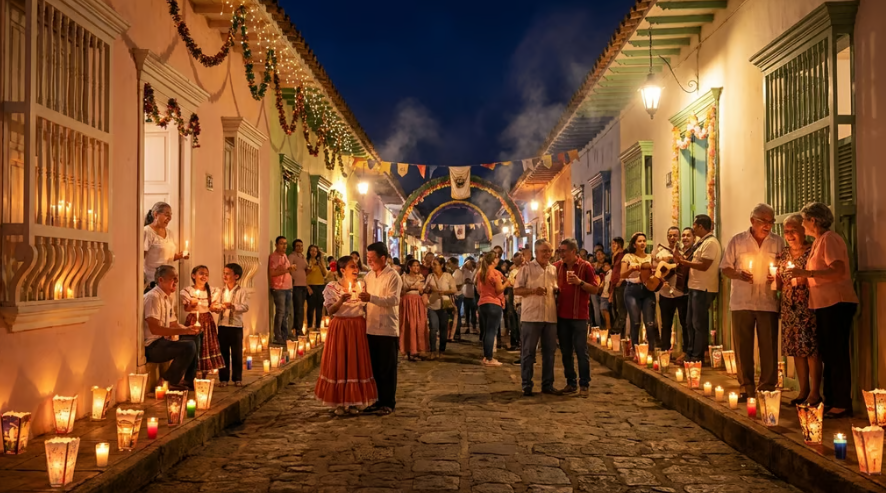
Colombia’s Día de las Velitas (Day of the Little Candles) on December 7th lights entire cities with millions of white and colored candles in paper lanterns, honoring the Virgin Mary.
Venezuela transforms Christmas morning in Caracas: residents roller-skate to dawn masses, a tradition so popular that streets are closed to traffic. Throughout December, families sing Aguinaldos (Christmas carols) during Las Patinatas, festive skating gatherings.
Brazil celebrates Papai Noel during summer heat, with beach gatherings replacing snow. The country’s traditions blend Portuguese Catholic heritage with African and indigenous influences.
North America
Canada celebrates l’Action de grâce (Thanksgiving) on the second Monday of October, predating the American holiday by nearly 150 years—the first Canadian Thanksgiving occurred in 1578.
The United States originated the televised Yule Log broadcast (WPIX New York, 1966) and continues developing new traditions. The Christmas pickle ornament—where the finder receives an extra gift—is marketed as a German tradition but appears to be an American invention.
Asia & Pacific Celebrations
Asian winter celebrations range from religious observances to commercial phenomena largely disconnected from religious meaning.
Japan exemplifies the latter: despite only 1.1% Christian population, Christmas has become a major commercial event. The defining tradition is eating KFC (Kentucky Fried Chicken), a phenomenon dating to 1974’s “Kurisumasu ni wa Kentakkii!” (“Kentucky for Christmas!”) marketing campaign. Families now pre-order Christmas KFC meals weeks in advance to avoid sellouts.
China has seen Christmas gain commercial traction since the 1990s, particularly in urban centers. A unique tradition involves gifting “peace apples” (píngguǒ)—the word for apple sounds similar to the Chinese phrase for Christmas Eve (píng’ān yè). More significant is the Dongzhi Festival marking winter solstice, when families gather to make Tangyuan (glutinous rice balls) symbolizing reunion and prosperity.
South Korea observes Chuseok, a three-day harvest festival often called “Korean Thanksgiving.” Families honor ancestors and share Songpyeon (half-moon rice cakes) while celebrating the autumn harvest.
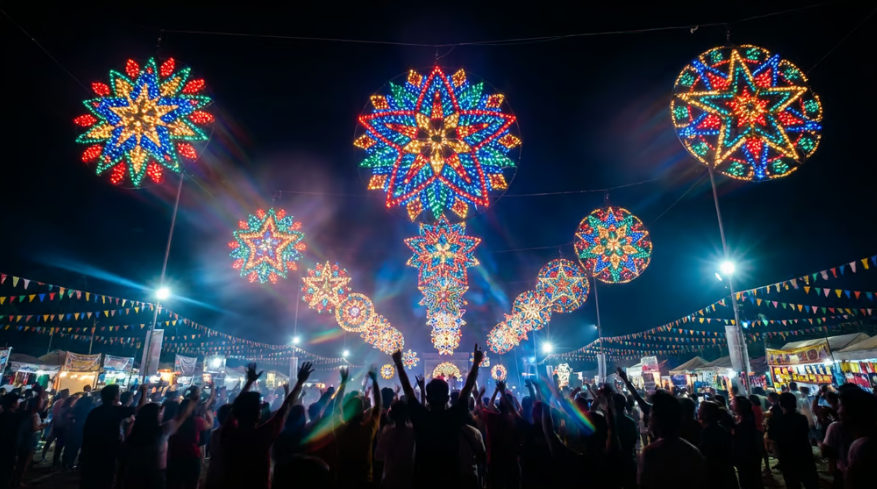
The Philippines claims the world’s longest Christmas season—the “Ber Months” beginning in September when Christmas carols start playing. The Giant Lantern Festival in San Fernando features enormous Parols (star-shaped lanterns) with thousands of synchronized lights, each requiring months of construction.
Australia and New Zealand celebrate summer Christmas with beach barbecues, outdoor gatherings, and Santas in shorts. The reversal of seasons creates distinctly different imagery from Northern Hemisphere celebrations.
Africa & Middle East
Ethiopia, where 44% belong to the Ethiopian Orthodox Tewahedo Church, celebrates Ganna (or Genna) on January 7th following the Julian calendar. The preceding 43-day Tsome Nebiyat (Fast of the Prophets) prohibits meat, dairy, and eggs. On Christmas Day, communities play Ye Genna Chewata, a hockey-like game with religious significance.
Ghana’s Ga people celebrate Homowo (“making fun of hunger”) between May and August, a harvest festival commemorating historical famine’s end. While not a Christmas tradition, it represents Africa’s rich heritage of thanksgiving celebrations.
Lebanon recognizes Christmas as an official holiday, reflecting the country’s significant Christian population. Traditions blend Eastern Orthodox and Western practices.
Other Major Winter Celebrations
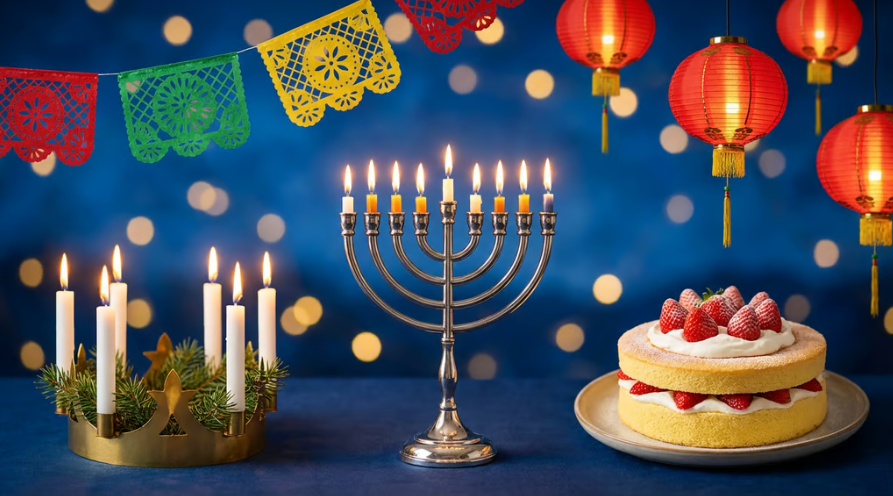
Hanukkah, the eight-day Jewish “Festival of Lights,” commemorates the rededication of the Second Temple in Jerusalem. The central ritual involves lighting the Menorah—one candle per night plus the Shamash (helper candle). Traditional foods include Latkes (potato pancakes) and Sufganiyot (jelly doughnuts), both fried in oil recalling the miracle of the Temple oil lasting eight days. Children play with the Dreidel, a four-sided spinning top.
Kwanzaa (December 26-January 1) celebrates African-American culture and heritage. Created by Dr. Maulana Karenga in 1966, the celebration focuses on Nguzo Saba—seven principles including unity (Umoja), self-determination (Kujichagulia), and collective work (Ujima). Families light candles on the Kinara and exchange gifts emphasizing creativity and learning.
Diwali, while primarily a Hindu autumn festival, falls within the broader winter celebration period in many regions. The five-day Festival of Lights celebrates the triumph of light over darkness, with oil lamps (Diyas), fireworks, and family gatherings.
Why Cultural Context Matters for Global Communication
Understanding holiday traditions extends beyond social politeness—it directly impacts business effectiveness and diplomatic success.
Scheduling considerations: Orthodox Christmas (January 7th) and lunar-calendar holidays shift annually. Assuming Western dates creates conflicts. The Philippines’ September-to-January Christmas season means different availability patterns than Northern European countries, where mid-December through early January sees complete shutdowns.
Gift-giving protocols: What’s appropriate varies dramatically. A bottle of wine works in France but may offend in Saudi Arabia. Clocks symbolize death in Chinese culture. The number four carries negative associations across East Asia.
Religious sensitivities: Assuming “Christmas” is universal alienates Jewish, Muslim, Hindu, and secular colleagues. Wishing someone “Happy Holidays” or understanding their specific celebration demonstrates respect.
At Chang-Castillo and Associates, cultural competence isn’t a bonus—it’s fundamental to interpretation quality. Our interpreters, graduates of elite programs and members of AIIC (International Association of Conference Interpreters) and TAALS (American Association of Language Specialists), bring experience from G8/G20 summits, United Nations sessions, and European Union proceedings where understanding cultural context determines communication success.
An interpreter who knows that “Jólabókaflóð” isn’t just “Christmas Book Flood” but carries specific Icelandic connotations—or who understands why January meetings might conflict with Orthodox celebrations—provides value beyond word-for-word translation. Cultural fluency turns adequate interpretation into exceptional communication.
Learn more about our interpretation services or contact us to discuss your international communication needs.