Miami conference interpreting services from Chang-Castillo and Associates (CCA) cover simultaneous interpretation for conferences, conventions and trade shows, consecutive interpretation for business meetings and negotiations, remote and hybrid delivery, and interpreting equipment rental. Translation of event materials and business documents is available alongside.
CCA is headquartered in San Francisco and keeps no Miami office. Interpreters and translators for Miami assignments come from its network. Request a free quote or call +1 (877) 708-0005.
Conference Interpreting for Miami Conventions, Trade Shows and Seminars
Conference interpretation from CCA covers international conferences, seminars, workshops, business meetings and training courses, the formats behind the conventions and trade shows Miami organizers run.
Miami events can bring together delegates from many countries. Miami International Airport’s own trade statistics show that it handled about $55.2 billion in Latin American and Caribbean air trade by value in 2025, with Brazil the largest partner at about $17.1 billion. Miami-Dade County’s International Trade Consortium organizes the annual InterAmerican Conference of Mayors and Local Authorities, and the 2025 edition drew more than 300 government officials and institutional leaders, including more than 40 mayors from 21 countries.
For events in Miami and Miami Beach, the Miami Beach Convention Center is the venue many organizers know. It is owned by the City of Miami Beach, a separate municipality from the City of Miami, and its published calendar runs year-round. Read in October 2026, the calendar lists an air cargo forum in October, a hospitality show in November, an international art fair in December, a boat show in February 2027, a banking and fintech conference for the Americas in March and a cruise industry trade show in April. Dates can change. With up to 84 meeting rooms across 1.4 million square feet, the center can host parallel sessions, and each interpreted room needs its own interpreting setup.
Language demand follows the population. In the City of Miami, 77.2% of residents age 5 and over speak a language other than English at home (Census Bureau QuickFacts, 2020 to 2024). In Miami-Dade County, the Census Bureau’s 2024 American Community Survey 1-year estimates show about 67% of residents age 5 and over speaking Spanish, roughly 100,000 speaking Haitian Creole and roughly 25,000 speaking Portuguese. CCA specializes in Spanish and Portuguese.
CCA’s conference interpreters are not court interpreters, because court assignments call for separate court certification.
Which Interpreting Format Fits Which Miami Meeting
The format follows the room and the audience.
A Multilingual Convention or Trade Show
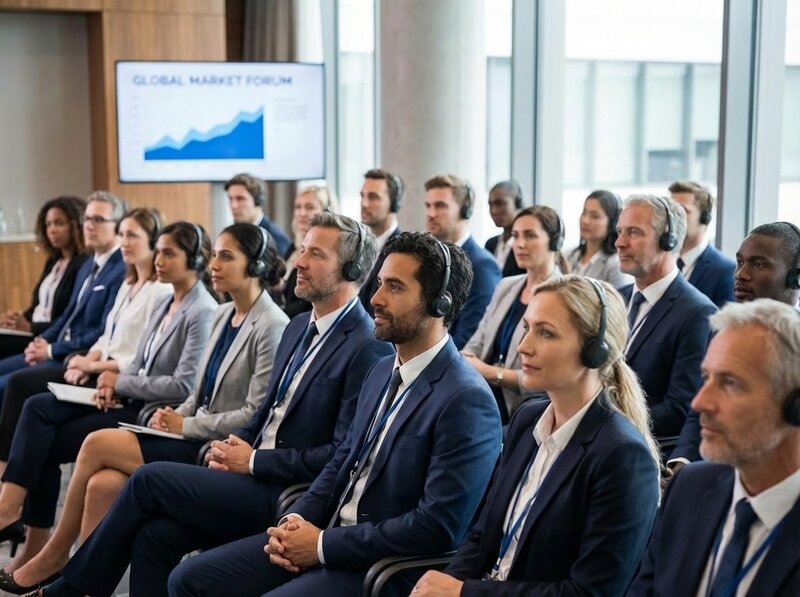
Simultaneous interpretation fits any program where the session cannot pause. In simultaneous interpreting, the interpreter speaks while the speaker continues, and delegates listen through headsets. This is the mode used at international conferences and multilingual seminars. CCA also provides interpreting equipment rental for these programs.
A Negotiation or Client Meeting
Consecutive interpretation suits small discussion groups and business negotiations. The speaker pauses after each passage, the interpreter renders it in the other language, and the room needs no equipment.
A Seminar or Training Course
Workshops, seminars and training courses can use either mode, and the choice rests on one question. A small group that accepts pauses can use consecutive interpretation, which lengthens the session because every passage is spoken twice. A session that cannot stop for each passage calls for simultaneous interpreting.
A Virtual or Hybrid Event
Remote simultaneous interpretation delivers interpreting from another location to participants through a delivery platform. Hybrid interpretation serves an event with some participants in the room and others online, all hearing the live interpreting of the session in their own language. The organizer settles two decisions early: which language channels the in-room audience and the online audience each hear, and where the remote interpreting takes place. AIIC’s distance interpreting guidelines recommend testing the equipment, sound and connection of key participants before the meeting and keeping a technician available, so the interpreting side should hear about any online component early.
Preparing a Miami Event for Its Interpreters
Each interpreter works from what is supplied, so the most useful preparation is getting written materials to the interpreter before the event.
The United Nations Office at Nairobi publishes a guide for requesting interpretation, with conditions devised in cooperation with the profession’s main association. It asks organizers to pass speeches and presentations on as soon as they are available and before delivery, whether or not the text changes later. Background papers help technical programs, and AIIC notes that interpreters use the papers they receive to prepare and build their own glossaries.
For a technical subject, professional guidance also recommends briefing the speakers and the interpreting side before the session, and naming one contact person for that side.
The online quote form asks whether the request is for translation or interpretation, the type of interpretation, the event name and subject, the event date and start time, the city and country of the event, and the language pair. List every language the audience needs. For a translation, the document type and the deadline go in the “Additional information/comments” box.
Translation of Event Materials and Business Documents for Miami
Translation from CCA covers the documents an event or a deal produces. These include speeches and presentations, marketing materials, training materials, corporate communications, legal documents, technical manuals, websites and software. Translators work into their native language, and translations are adapted to the target market.
A dedicated project manager is in charge from the start of the project to final delivery. No fewer than three separate linguists work on each translation: a translator who prepares the first draft, an editor who checks meaning, style and nuance, and a proofreader who checks typos, punctuation and formatting. IT specialists, engineers and desktop publishers join the project if necessary.
Glossary management, management of in-country review cycles, multilingual desktop publishing, subtitling and transcription are available as additional services. Rush service is available for translation projects with short deadlines.
Who Interprets: Credentials and the Interpreter-Owned Model
Every CCA conference interpreter is a high-level professional who must hold at least two of five credentials: an MA or PhD in conference interpretation from a recognized school; membership in the International Association of Conference Interpreters (AIIC), which admits members through peer review; membership in The American Association of Language Specialists (TAALS), also awarded through peer review; at least five years of conference interpreting experience and proof of at least 200 days of conference-level work; or accreditation with the United Nations, Canada’s federal government (conference level), the European Union’s interpretation directorate, the US Department of State (conference level) or NAATI Level 5.
The roster includes professionals who work with UN agencies, at G8 and G20 summits, at the Olympic Games and at presidential and ministerial meetings. Translators hold professional translator training and credentials.
CCA describes itself as the only simultaneous interpretation firm exclusively owned and operated by translators and interpreters.
How many interpreters does a full-day conference in Miami need?
Professional standards set the team by the number of languages interpreted and the length of the program, so a conference interpreted into three languages needs more booths than one interpreted into two. AIIC’s standards call for a team of at least two interpreters per language and per booth as a general rule, with a normal working day of no more than two sessions of 2.5 to 3 hours, and AIIC’s guidance to organizers gives 30-minute shifts as its example. The United Nations Office at Nairobi gives the same shape: sessions of no more than three hours, with a break of at least 90 minutes between morning and afternoon.
Where do interpreting booths go at a Miami convention venue?
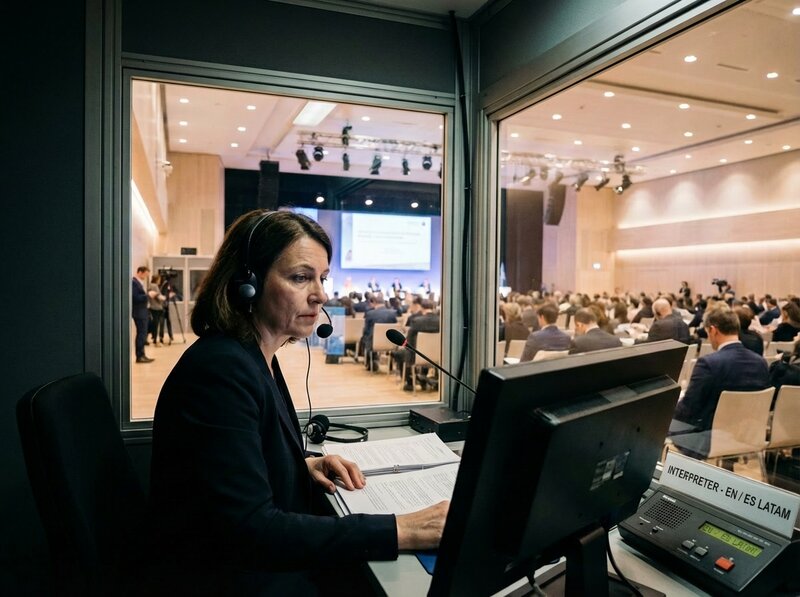
An interpreting booth is the enclosed workstation where each interpreter works; an exhibitor booth at a trade show is the stand on the exhibit floor. Interpreting booths go where the interpreter has a clear view of the speaker, and any screen must be visible from the booth. Video played in the room needs a direct audio feed to the booth. According to AIIC guidance, the team leader and a sound engineer check the equipment before the program begins. The industry standards are ISO 17651-2:2024 for mobile booths set up in a room and ISO 20109:2025 for interpreting equipment. Before booking, ask the venue whether its audio-visual equipment rules apply to interpreting equipment.
Which Spanish and Portuguese should a Miami audience hear?
The variant follows the audience’s country or region. CCA adapts translations to the target market, for example Latin American versus European Spanish, and the same logic applies to interpreting. Brazil is the largest partner in the Latin American and Caribbean air trade of Miami International Airport by value, which may point a Miami business audience toward Brazilian Portuguese, though the delegates decide. Brazilian and European Portuguese differ in spelling and vocabulary. For an interpreting assignment, name the country or region the delegates come from. CCA’s Spanish language services cover interpreting and translation for Spanish-speaking audiences.
Does hurricane season affect an interpreted event in Miami?
The Atlantic hurricane season runs June 1 to November 30, with a peak around September 10 and most activity between mid-August and mid-October, according to the National Hurricane Center. Programs held between June and November fall inside the season, so an organizer can decide in advance which sessions could move to remote simultaneous interpretation or be rescheduled.
What goes into a quote for conference interpreting in Miami?
CCA publishes no rates, and quotes are free. Send the event details listed in the section on preparing an event, and CCA sends a quote.
Request a Free Quote for Your Miami Event
Contact CCA online, call +1 (877) 708-0005 or write to info@chang-castillo.com.